Saturday, March 17, 2007
Chi- Hoon
Chi- Hoon by Patricia McMahon is the photo/ diary compilation of a young girl growing up in Seoul, South Korea. This beautifully glossy portfolio follows Chi- Hoon through a week of her life, giving the reader rich insight into cultural customs and traditions. Since my students were very excited that I was going to Korea, I promised to bring back something that we could learn about as a class. This book is the perfect instructional jump- off point: The reader can select virtually anything from the book and delve into a cultural study of it.

Josephine's 'magination by Arnold Dobrin
Couldn't find a picture for this one, and it was first published in 1973 so this may be due to an elderly book. not sure. Regardless, this is a great book for teaching multi cultural education. I chose this book for a couple reasons. One thing i really liked about this book is that it doesn't hit you over the head with the multi cultural content. What i mean by this is there is no racism or injustice really in the book. Instead the author chooses to tell a story of a young Haitian girl who accompanies her mother to the market one day to sell brooms, where she meets an older man who explains to her that she can make new things out of old stuff using her imagination. The illustrations are vivid, alternating between color and black and white, and the book would be appropriate for K-3rd grade, however it is not a short book, with about half text/half pictures for every 2 page spread.
The multi-cultural content comes from the book taking place in a poor neighborhood on Haiti, a country i assume most young urban students are not familiar with. Students learn about different cultures and people and there is also a bit of self love and acceptance in regards to the character of Josephine. (she learns she can have fun and make toys even though she has no money to buy anything, accepting her situation and making the best of it) I would use this book as an opportunity to introduce Haiti and Haitians to students. Where is Haiti? What continent is it located on? What is the weather like there? Can we determine any of this from the illustrations or how the people dress? What language do they speak in Haiti? (French) Why do they speak French? (Haiti was a French colony as well as many other North African states)What's a colony? etc. you get the idea. Any number of engaging and enlightening questions could be asked. For more advanced or older students you could have them do their own research and investigations into the Haitian people, culture, and history. One must keep in mind however to prepare students with adequate research skills and strategies before assigning such an activity.
The multi-cultural content comes from the book taking place in a poor neighborhood on Haiti, a country i assume most young urban students are not familiar with. Students learn about different cultures and people and there is also a bit of self love and acceptance in regards to the character of Josephine. (she learns she can have fun and make toys even though she has no money to buy anything, accepting her situation and making the best of it) I would use this book as an opportunity to introduce Haiti and Haitians to students. Where is Haiti? What continent is it located on? What is the weather like there? Can we determine any of this from the illustrations or how the people dress? What language do they speak in Haiti? (French) Why do they speak French? (Haiti was a French colony as well as many other North African states)What's a colony? etc. you get the idea. Any number of engaging and enlightening questions could be asked. For more advanced or older students you could have them do their own research and investigations into the Haitian people, culture, and history. One must keep in mind however to prepare students with adequate research skills and strategies before assigning such an activity.
Friday, March 16, 2007
Somewhere Today... A Book of Peace

Somewhere Today..A Book of Peace by Shelley Moore Thomas
At first I felt as though this book did not really have much to do with peace at all because it only presented alot of positve scenarios, but after observing the literary specialist in my school do a read aloud with this book I realized that there is alot of potential to discuss what peace is and contrast the postive imags with other negative aspects as well. This book goes through different activities that children are doing throughout the world that help make the world a better place. I love that the book has actual photographs rather than illustrations as well. More than that this book presents taking social action in a way that children can relate to and dispels the idea that social action has to be some grandiose display, that way children can see it is possible to be a social activists no matter how old and how little a taks may seem.
Social Justice
4.Social Movements and Social Change
5. Taking Social Action
Lesson Plan Ideas.
I think this book would be a great book for a writing unit where children are making their own books, as well as a poetry unit.
Wednesday, March 14, 2007
"I Love My Hair" by Natasha Anastasia Tarpley

Title: "I Love My Hair"
Author: Natasha Anastasia Tarpley
Summary: "I Love My Hair" deals with a young African American girl who describes her hair in many unique ways and the different ways she can wear it as well. This book is definitely empowering and brings an excellent message about appreciating who we are and where we come from. In addition, it encourages kids to feel proud of their heritage and appreciate each individuals uniqueness.
Reflections: I strongly recommend this book for any grade level. Its illustrations and colors make images vivid and immerses readers into a realistic flight of heritage celebration. Overall, it is a beautiful story about self-love and acceptance.
Social Justice Education: This book could be used in lessons that deal with self-love and acceptance, respect and tolerance for oneself and others, and exploring issues of social justice in the classroom. Also, it is great to read to students when introducing appreciation of diversity in the classroom.
Lessons and activities: This book is an excellent resource to use when teaching a lesson on the Appreciation of Diversity. First, I would read this book to my students and after ask them to draw self-portraits. When finished, I would allow students to comment about their differences in a positive way while they travel around the room viewing their drawings.
You may also want to visit this interesting link: A unit on "Celebrate your Heritage"
http://content.scholastic.com/browse/unitplan.jsp?id=50
Stand Tall, Molly Lou Melon
 This book is a "heart-warmer" about a little girl named Molly Lou who is smaller than all the other children her age. Her character is developed after she moves to a different town. She always remembers what her grandmother told her and is able to battle the bullies.
Stand Tall, Molly Lou Melon would be useful in the younger grades as it has very simple language and bold pictures. This would be good for character development lessons and the theme of being proud of who you are. It also is a good example of how we need to to accept people who are different than us. Some possible lesson ideas would be to have children compare the situations from the book to things that have happened to them. Another idea would be to use this as one book in a character study unit. Students could record aspects of Molly Lou and what makes her who she is.
This book does not reach all of the levels of social justice education. It clearly touches on self-love and acceptance as she is constantly reminded that she can do what everyone else can do. It is also able to be incorporated into the "respect for others" category because the bully Ronald learns to accept Molly Lou for who she is.
Some useful links:
http://www.uen.org/Lessonplan/preview.cgi?LPid=10582
http://www.meac.org/Resources/LessonPlans/pdf/Primary_stand.pdf
http://teacher.scholastic.com/lessonplans/bookfairs/currconnection/like_myself.htm
People

Written and Illustrated by Peter Spier
People is an excellent book to use in the classroom to expose students to the differences in people from around the world. Spier's book sends the message that everyone has the right to be different and that people should be proud of their differences. Spier examines an array of characteristics that make human beings unique. His words and illustrations show the differences in physical traits (body size, skin color, eye color, hair style), clothing styles, interests, dwellings, holidays, foods, religions, and languages of individuals from many cultures. At the end of the book, Spier asks the reader to imagine how dull the world would be if everybody looked, thought, ate, dressed, and acted the same. This book makes you think about how wonderful it is that each one of us is unlike any other.
Anne Marie and Bree pointed out one area to watch out for: towards the end of the book, Spier writes about the different kinds of leaders. We noticed that the illustrations for this page are all of white males. When using this book in the classroom, it might be beneficial to discuss this or to skip the page entirely.
I think this book touches on the first three levels of social justice. When reading this book, children and adults consider their own cultures. They also learn about cultures that are different than their own. Spier helps his readers realize the importance of differences in the world.
Tuesday, March 13, 2007
Fire at the Triangle Factory by Holly Littlefield
Fire at the Triangle Factory by Holly Littlefield
Available for Purchase at: Amazon
Summary: This book is about two 14-year-old girls, Minnie a Jewish girl and Tessa an Italian Catholic girl, seamstress coworkers in a crowded work factory on the upper floors of a building in Greenwich Village (Now the Silver building on NYU’s campus) in 1911. One day a fire breaks out in the factory, resulting in the deaths of 146 workers. The book tells the story of the two girls struggle for survival. This historic event in history changed the labor laws and safety codes for the future generations.
My Opinion: I love this story because it tells a story of child labor, religious differences, and overlooked labor laws. It is a story of tragedy that results in social change. It also is very relevant for children in New York City because it tells of specific landmarks and communities that the children live in today.
Possible Topics: You could use this book for numerous lessons and unit studies! It covers topics of labor laws and how they were neglected and obscure before the fires. It covers child labor. It discusses the importance of safety and evacuation plans. It discusses the life of immigration work and New York City. It also talks about the religious differences and family opposition among the Catholics and Jewish communities of the early 20th century.
Lessons in literacy/ social studies:
· The students can role-play and write a letter from one of the girls’ perspective to the other girls’ perspective telling about why they think their parents dislike each other.
· Write diary entries from the girls’ perspective about the daily life in the factory or the day of the fire
· Write letters to the government officials to make labor laws stricter and enforced
Lessons in math/social studies:
· The students can research and calculate how much money the workers made at the Triangle Shirtwaist Factory
· The students can calculate the ratio of how many people died in the fire and how many people were working there.
Lessons in Science/social studies:
· The students can research how the fire began and what caused the fire.
· What made the fire spread so rapidly?
· Brainstorm solutions and preventions that could have been enforced to prevent the fire.
Monday, March 12, 2007
Angel Child, Dragon Child
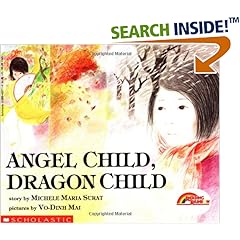 Angel Child, Dragon Child
By Michele Maria Surat
Summary: Ut is a new girl that has just come from Vietnam. The students in her class make fun of her because of her language and identity. She struggles attending school in the United States. Her mother is left behind Vietnam, but her once enemy, but now friend at school, gives her a big, great surprise at the end of the story that she will never forget.
Activities:
1) This book would be great to read on the first day of school. It will allow students to understand how other students might feel on the first day. Students can also learn that English is not the first language for all students. The teacher can maybe speak in another language and ask the students how they felt when they heard the language. This will allow the students to think about how others would feel.
2) I also think this would be a great book to introduce the Asian culture. Since many students might assume that all Asians are Chinese, this book can lead to an Asian culture study. Students can learn that Asians are Chinese, Korean, Japanese, Taiwanese, Indonesian, Vietnamese, etc. I find that it is important to understand that concept.
3) This would also be a great book for students to understand what it means to help others. One of the characters in the book help Ut, the Vietnamese student, bring her mom to the States. This can help create a positive learning environment.
Social Justice Education:
I think this book mentions self-love and acceptance, respect for others, and taking social action. Students learn to love themselves and their culture, have respect for the cultures of others, and also learn the importance of helping others out.
Sunday, March 11, 2007
The Keeping Quilt

A little girl, Anna comes to America from Russia with her family. When her and her family's clothes don't fit anymore, they use scraps of it to make a beautiful quilt to remind them of backhome. The quilt served many purposes throughout the years, as a wedding huppa and wrapping the newborns of each generation. The quilt is passed on to each daughter.
This book is a great memoir piece that uses an item, the quilt as a unifier. It is also great for studying cultures, traditions, immigration and families. It explores the changes that most families go through after they immigrate to America.
SJE:
1. Self Love and acceptance: the family is Jewish and passes on the traditions and cultures to each generation.
2. Respect for others: exploration of Jewish culture; throughout the generations, more people of other cultures are invited to the Jewish weddings.
3. Exploring issues of social justice: the symbolism of the quilt- all the things the family left behind to come to America and what identifies them.
Don't Laugh at Me!

This book, "Don't Laugh at Me", by Steve Seskin and Allen Shamblin, with illustrations by Glin Dibley, is really a book form of the song "Don't Laugh at Me!" by Peter Yarrow (of Peter, Paul, and Mary fame). It is an excellent resource for teaching an anti-bullying curriculum, as well as for the opposite of bullying, community building. It's hard to find in print (none of the book stores down here had it, but there was talk of the Barnes and Noble on 82nd...right...), but it IS still in print, and apparently comes with a recorded version of the song, which I think is really helpful for students who maybe can't read the words on their own.
My main concern with this book, however, is the fact that 'the chorus' says, "In G-d's eyes we're all the same", which is a really nice sentiment, but isn't great for community building if some students in your class don't believe in G-d or might get upset because they believe in another G-d or a different version OF G-d. I would try to find a more neutral way of expressing it - I was playing around with "in real life, we're all the same".
I believe this book hits the following levels of Social Justice Education:
1) Self-Love & Acceptance: it's okay to be different
2) Respect for Others: The basis of not bullying
3) Exploring issues of Social Justice: Why people get bullied, even though it's not okay OR their fault
4 & 5) dependin on how you use it: if you use it to discuss how a person's skin color has been a source of discrimination for hundreds of years, you could work this book in. If your students want to create a school-wide anti-bullying campaign, this would help.
Links:
http://www.operationrespectct.org/
http://www.operationrespectct.org/song.htm (a page with the actual song playing behind it!)
http://www.antibullying.net/
www.mikebogdanski.com/
http://www.theantibully.com/
links reviewing the book:
http://www.bookloons.com/cgi-bin/Review.ASP?bookid=3134
http://www.curledupkids.com/dontlaff.htm
http://www.amazon.com/Dont-Laugh-Reading-Rainbow-Book/dp/1582460582
Subscribe to:
Posts (Atom)