Tuesday, January 30, 2007

Number The Stars


Number The Stars
By: Lois Lowry

Summary: This is a factually based story about a young girl named Annemarie Johansen and her best friend Ellen Rosen. Lois Lowry wrote the book based on the stories of a life-long friend of hers who experienced many of the hardships and events described in the book. The setting takes place in 1943 in Denmark during World War II. The story is written in third person, through the eyes of ten year old Annemarie, so the language is age-appropriate and easy for children to understand. The story begins with word getting around in Copenhagen, the town where the girls lived, that the Nazi soldiers were here invading their town and kidnapping the Jewish people and send them to concentration camps. Ellen, Annemarie's best friend, was Jewish, so she and her family were in great danger. Ellen stayed with the Johansen's and pretended to be Annemarie's sister, but they ran into many troubles. One night, the Nazi soldiers came to Annemarie's house looking for Ellen's family, but they tricked them into believing that Ellen was a part of the Johansen family. After that incident, Annemarie's family thought it would be safer for the girls to go live with their uncle Henrik instead. The story continues with Annemarie trying to find the courage to save her best friend's life, but she cannot hide her fears.

What drew you to this book?: I noticed that the book received a Newbery Medal and the little girl on the book cover looks so innocent. Once I started reading the book, I could not put it down. I wanted to continue reading to find out what happens to Ellen and her family at the end of the book. When I read books, I like to put myself in the characters role and imagine the events occuring as I read on. The fact that this was a true story made me sympathize with the characters even deeper. I also love how the book is age appropriate for young readers and that the story is written through the eyes of a young girl, so the students get her perspective. There is so much history behind the story and the details make it easy for the reader to form a picture in their mind of what life was like during that time period.

Activities/Lesson Ideas: The story touches on a variety of themes; for example the friendship between the two girls, Annemarie and Ellen, is very strong. Annemarie held onto Ellen's Star of David necklace as a way to symbolize the bond that they both shared. She had to go take many risks and troubles in order to save the life of her best friend, yet she somehow found the courage to keep on going. Bravery is another theme that plays out throughout the story. Annemarie's uncle taught Annemarie that it is okay to be scared. He told her that being brave means "somehow ignoring the dangers of a situation , often because one does not fully understand it".


  • One lesson idea might be to have the students create character webs listing the different characteristics of the two characters. Then they can compare and contrast the two.

  • Another lesson idea might be to study symbols and what they mean. In the story, symbols represent different people (i.e. the star of david necklace represents Judaism).

Number the Stars has a strong historical connection to World War I and the holocaust period, thus it would be great to use this book in a unit on the World War. The story touches on events like the invasion of Denmark, and the Danish resistance. One of the characters in the book, Peter, is a fictional character who represents the many young men who fought and those who died as members of the Danish Resistance.


  • A lesson idea might be to study the Danish Resistance and how they came about, while using the character of Peter to help the students understand what life was like for a member of the Resistance.

  • A lesson idea might be to study what life was like for children during the Holocaust and War period. The students could pick a character they feel they most identify with or feel for and write them a letter telling them how they feel (i.e. write a letter to Annemarie letting her know that you admire her bravery and that everything is going to be okay).

  • A lesson idea might be to explore anthropology as the students learn about the Danish culture and Jewish culture and traditions.

  • A lesson idea might be to integrate georgraphy and have the students locate and plot where Denmark and Sweden are on the map.

Domains of Social Justice: This book definetly touches on three of the domais of social justice.


Self-Love and Acceptance- Annemarie does not understand everything that is going on, but she continues to stay strong and hope for the best for her friend. She begins to understand that it is okay to be scared and that it doesn't translate to not being brave. I think the students will be able to relate to her on that level because everyone has, in one point in their lives, felt scared about something.


Respect for Others- Annemarie and Ellen both value friendship so much that they will do anything to keep that bond strong. They don't let the fact that they come from different cultural backgrounds get in the way. They respect one another and care for each other a great deal.


Taking Social Action- Annemarie and her family take risks to save their dear Ellen. Annemarie's uncle has a boat that he uses to smuggle the Jewish people to Sweden.


Where to purchase the book: Amazon website- http://www.amazon.com/gp/product/0395510600/ref=pd_kar_gw_2/105-8984657-6750815


Useful Resources:


Website includes everything you could ever need from resources for teachers to activities and lesson plans for students. It includes passages about the brief history of the struggles of the Jews at the hands of Hitler and the Nazi Party, fate of children, life under German occupation, etc.


  • The Star of David article
http://www.stemnet.nf.ca/CITE/ns_star_david.pdf

Potatoes, Potatoes by Anita Lobel


Summary:

This book describes the story of a mother and her two sons and their lives together as potato farmers during a war between the east and west armies of their country. The mother tends to the potatoes and builds a cottage and a farm that house potatoes, all for her sons, so that their family never can go hungry. One day, the boys decide that they are tired of growing potatoes, and want to join the army. Without telling each other, each brother signs up for opposing armies: Red and Blue. One brother becomes the commander for the Red army, while the other brother becomes the commander for the Blue army. After years of battling, there is no more food available for the people of their country, or for both the Red and Blue armies. The brothers lead their armies to their mother's cottage, and demand food from the potatoes she had harvested all throughout the war. Soon, a war breaks out for the potatoes, and the mother's cottage is destroyed. The brothers begin to cry, realizing the harm they've caused. Seeing this, all of the soldiers think back on their days with their families and begin to cry. Finally, the characters decide that everyone will only get potatoes and food if they stop the war and return home.

Reflection:

I enjoyed most of the book. It read like a legend or a folktale, rather than a non-fictional narrative piece, which provided features of storytelling. I enjoyed the general theme of the story, which was of a family involved in war, their struggles, and the outcome of their actions during the war. I thought the book was one that touched base on the issues and impact of war, but it did not divulge in depth into these areas, which is O.K. for a beginners study and introduction. I did not like the ending of the book, however, which only stated that the soldiers who decided not to fight went back to their "mothers". I felt if I were using this book, of which I enjoyed most of it except for this feature, I would change the ending. Instead, to be more politically correct, as well as less stereotypical, I would have liked if the book stressed the importance of all families, not just the importance of mothers.

Activities:


  • I would use this book as an introduction to making a list of the impact of war on families, and what war may lead to in future experiences. As a gateway into this discussion, this book could trigger discussions based on the impact of war, by describing what happens to the mother in the story, the relationships between the two sons, their soldiers, and their mother, and the roles of citizens who are living in war-like situations (in the book).

  • For ELA instruction, students could take on the different perspectives in the book: the mother, the younger son, the older son, and the soldiers in their armies. Students can write letters to other characters in the book, in the perspective of the characters they've chosen. Students will represent different opinions about war within the book, and can lead discussions, or present a debate based on their letters.

  • Students can study the importance of food, and in particular, the potato, during war. Students can figure out mathematically how many potatoes would be needed to feed the opposing armies as well as the surrounded townspeople who were left without food. Students will get a greater appreciation for how important and scarce food can become during a time of crisis.

  • These activities correspond to the ELA, math, and social studies curricula.

Social Justice Education:


1. Self Love and Acceptance: Students will observe the roles of the two sons within the story and their growth within the story. Both sons decide to leave their roots because they are tired of doing the same things day after day with their mother, but come to realize the importance of raising the potato crop because of its ability to unite their country and their own family.


2. Respect for Others: Students will learn that everyone, no matter who they are, regardless of race, ethnicity, religion, or status, needs the same resources, such as food. Because of this, in the book, the countries, soldiers, and townspeople decide that war is not a solution to their problems.


4. Social Movements and Social Change: Students will learn that the characters within the book decided that war only provided chaos and limited resources that were beneficial to the soldiers, their families, and their country and governments. In this way, they realized that fighting had to be ceased in order to truly provide for their families.


New York Is English, Chattanooga is Creek


New York is English, Chattanooga is Creek
By: Chris Raschka

New York Is English, Chattanooga Is Creek is a great book that takes you to the pplanning of a party and the the actual party itself. You begin the book with an introduction to New York who is an English Duke and to his friends, Chattanooga, Minneapolis and a few others. The author continues to introduce you to many other city names and their origin. His illustrations support the origins of the names. When they are all together you see how diverse the names and the faces that go with the names are.
This book made me laugh so much. This book was such a creative message to readers on the diversity of this nation. Raschka does such a great job at saying that we are all from different backgrounds, but one nation. I like how it is simple and colorful and straight to the point. The illustrations are powerful in showing us how we all look different and how we can ultimately come together.
A few activities that I ould do with this book are...
-Have students tell each other were their name comes from and place their name and definition and/or orgin on paper and decorate to hang around the room. The students can share their "All about my name" project with the class.
-Have students choose a name in their town or choose a different city/town name within the country (that wasn't hilighted in the book) and research its orgins.
-We can come u with our own version of the book and present it to the school.
Social Justice Education
1. Self-love and Acceptance: the students will have a chance to get to know many of the names that they are familiar with and learn that these names could come from where their families are from.
2. Respect for Others: learning about the diversity of the nation and discussing how diverse we are ass a class helps them to see that we are all mixed and that in order to continue to make our nation what it is, we need to respect and appreciate the amny differences that we have.
3.Exploring Issues of Social Justice: this book doesn't really touch upon issues of social justice, but we can turn it into something like that. For example (and this can be an activity) we can analyze the illustrations. New York is drawn as a pasty white man, which comes off as a slap in the face to New Yorkers.
4. Social Movements and Social Change: this is not confronted in this book.
5. Taking Social Action: again discussing how and why the illustrations are the way they are can lead to how we can change the way people stereotype.

Curricular Units:
-Social Studies: geography
-Math: Origins and their dates

Monday, January 29, 2007

Mrs. Katz and Tush

Mrs. Katz and Tush (Patricia Polacco) is about a young African American boy, Larnel, who develops a close relationship with his Jewish neighbor, Mrs. Katz. She shares stories from her past and tells him about her experiences as a Jewish woman. She drews connections between Jewish and African American history, explaining how their races are very much alike. She shares Jewish culture with Larnel through food and even holidays. The story explains how friendship can bridge gaps in age and race. Though Larnel and Mrs. Katz possess a great deal of physical differences, they have many similarities.

I would use this book in my classroom to help students understand that even people who appear to be different are actually very similar. Together we would create a chart that explains how Mrs. Katz and Larnel possess both similarities and differences. Then I would pair up the students so that they can could find similarities and diffferences among themselves. The book also explains how people who are unfamiliar with a particular culture can still appreciate those customs and ways of life. Though Larnel was not Jewish, he still enjoyed eating Jewish food and celebrating Passover with Mrs. Katz. I would ask my students if they have a close relationship with someone of another culture. We would talk about how those differences make their relationship interesting and how they share their own cultures with each other. Students can also interview each other or people in their neighborhoods who come from a different race or practice a different religion. This would help students to accept and celebrate different cultures.

Mrs. Katz explains how African Americans and Jewish people are similar. They have both experienced hard times and suffering, yet they found ways to overcome it and found strength within themselves. Both cultures have been oppressed and forced to live in a way that they did not agree with. With my students, I would have discussions about these similarities. We would discuss the treatment of Jewish people and African Americans, as well as other oppressed groups of people. We could also discuss the ways in which the two groups fought for change. From there my students would realize that many cultures have unfairly suffered from injustice but found ways to promote change.

This book falls within each stage of social justice:
1. Self-love and acceptance - Students learn to appreciate their culture by sharing it with others.
2. Respect for others - As they read about Mrs. Katz and Larnel's relationship, students will learn that people should respect other cultures and celebrate them.
3. Exploring issues of social justice - When Mrs. Katz compares Jewish people and African Americans, she touches upon the ideas of racism and oppression.
4. Social movements and social change - Though the book itself does not provide specifics about the ways in which people have struggled for social change, it can spark conversations about individuals who have helped different groups of people find freedom and equality.
5. Taking social action - After reading this book, students can begin thinking about groups of people who are currently being oppressed and discuss ways in which they can work for change.

Here is a link to a website that tells you how to use the book to teach anti-semitism. The second link gives a list of quotes from the book that you can use to address various concepts, such as Jewish language, immigration, and holidays.
Challenging Anti-Semitism
Mrs. Katz and Tush Reference Page

IT's Okay To Be Different!


Title: It’s Okay To Be Different
Author: Todd Parr

Summary: Todd Parr does an excellent job of showing children the various appearances and personalities that exist in the world. Each page is filled with a description and bright illustration of how it is okay for people to come in different shapes and sizes, for people to be a different color and for people to act differently. There are also illustrations that show acceptance for people who speak different languages and even people who can not walk. The book ends by letting children feel happy about a way that they are different and telling them that those differences make them special and that difference in general make the entire world a better place.

Lesson Ideas: I have yet to use this book in my 1st grade class but I feel that this book would be a great introduction for a K-3 grade class on a unit of tolerance.

Students can explore what happens to people in places where they do not feel it is okay for everyone to be different and how they feel about that.

Each page that explores a different difference can be a lesson on race for the page that talks about being a different color or for the page with people speaking a different language, a lesson about ethnicity.

Social Justice:This book I feel fits into 1 and 2. It allows children to love themselves in learning about their own and their peer differences

We All Sing with the Same Voice


Title: We All Sing with the Same Voice
Written By: J. Philip Miller and Sheppard M. Greene
Illustrated By: Paul Meisel

Level: Pre-K-Second

Summary: This is a wonderful story about children from all over the world creating music using a common instrument; their voice. This book is actually the lyrics of a children’s song that was made popular on Sesame Street. The illustrator, Paul Meisel, has done a terrific job of celebrating and encouraging diversity through bright, colorful pictures. The book not only includes pictures of children from different countries and of different nationalities but it also includes pictures of children in wheelchairs who have handicaps and/or disabilities. It includes pictures of children from the city and of children from the country. This book does a good job of addressing ever aspect of race, gender, culture, and sexuality . It does a wonderful job of showing how we are all different but we also all have similarities.

Activities: This story comes with a CD of the original song that inspired the creation of the book. Children can listen to the song while following the words in the book which can help increase their fluency and word recognition. The book teaches that although everybody looks different on the outside, we all share similarities with one another as well. It teaches children to be open and excepting of everyone. Music is a great way for children to share a part of their own culture or identity. They could share a song from their country or even just a song that they enjoy a lot. I would use this book to start a unit on tolerance if I find that my students are not accepting of people who are different then them. This would be a good book to use if you do have a student with a disability and you notice that other students are not playing or interacting with that student because they are different.
Levels of Social Justice: With a little bit of creativity from the teacher I think that this book can fit into four or even all five of the levels of social justice. It definitely teaches children about their own culture as well as others and the importance of respecting others. Although the book doesn't go into much detail about issues of social justice it does bring up issues that could be controversial such as gay/lesbian moms and dads. The book can be used as a good intro into discussions about the differences between families as well as the way that other people live.

The Other Side


The Other Side by by Jacqueline Woodson is an educational book with amazing, life-like illustrations that assist the story in captivating the reader. It is about an African American and White girl who each live on their respective sides of a fence but can not stop wondering about each other even though they know they are not allowed to cross over the fence. Soon enough the girls begin to speak to each other and immediately become best friends. They even find a very clever way to abide by the rules of the fence by sitting on the fence, neither crossing to the other side. They spend the entire summer up on the fence, talking and sharing their lives with one another hoping that one day, someone will come and knock the fence down.
I was drawn to this book because of the interesting way that the author uses the fence as a central metaphor for the bigger issue of segregation. It is a story of the era of segregation through the eyes of children which engages young readers of today. The illustrations are also very beautiful and realistic. I feel like this book is a wonderful way to introduce the issue of segregation and Civil Rights in a classroom.
I would use this book to launch a unit on segregation and Civil Rights in my classroom. Students can explore the many different ways that segregation influenced the people of that time period and how, although said to have ended years ago, continues in our society today. I would encourage my students to think about when in their lives have they felt like the characters in this book. What do they feel or have felt is between them and another person in their life or between them and the achievement of their dreams?
This book is also an excellent example of poetic language and imagery. It can be used to teach students about how authors use metaphors, similes and symbols in literature to achieve a certain goal and outcome in their readers minds.
The Other Side fits into three of the five Stages of Social Justice. Students learn Respect for Others through understanding the struggles faced by African Americans during the years of segregation and continuing afterward. Through this book students can also Explore Issues of Social Justice such as racism and the negative and long lasting effects it has had on our society. Lastly, students will learn about Social Movements and Social Change through the study of the Civil Rights Movements and the leaders responsible and involved in this movement.
This book can connect to many curricular units such as segregation, as mentioned before. Civil Rights, the laws and movement. Brown vs. Board and the issue of desegregating schools. It can also be used to analyze where we stand today in regards to segregation, civil rights and racism.
Below are a few links to lesson plans and activities that can branch out from The Other Side:
http://pbskids.org/wayback/civilrights/features_school.html
http://www.tolerance.org/teach/activities/activity.jsp?cid=41
http://www.educationworld.com/a_lesson/lesson/lesson333.shtml

Sunday, January 28, 2007

The Black Snowman


Summary: The Black Snowman, written by Phil Mendez and illustrated by Carole Bayard, is a heart- warming tale of a child's journey towards self- love and acceptance.

The story, laced with its colorfully rich illustrations, begins long ago in western Africa. Here, an aged storyteller wraps his magic kente close to him, and summons the tales of memories past. The village children grow up and have children of their own, who also run to hear the lore of the storyteller. "But one day the storytelling comes to an end."

The village is seized by invaders and the African people are taken from their home and sold into slavery. All is lost. Even the magic kente is lost. "A thousand uses fray its delicate threads until it is discarded as a useless rag. But it still possesses the magic... it still has wonders to perform."

Cut to modern- day New York City. Jacob Miller is a poor black boy growing up in the projects. He lives with his mother, who tries her hardest to make ends meet, and younger brother Peewee. During the first part of the book, Jacob explores several issues of social justice, repeating the words that he has heard others say: "Everything black is bad! You ever hear of the Black House? No! But there's a White House. A white tornado cleans your sink; a black one destroys your house! And how about the fairy tales? It's the white knight who wins, the black one who loses. Good magic is white; black magic is bad."

Peewee implores his big brother to play in the snow with him, and Jacob begrudgingly obliges. As the two boys run out into the alley, Peewee asks Jacob to build a snowman with him. Jacob retorts, "We can't build a snowman. Just look look at that snow. It's watery and black from all the people trampling on it." However, Peewee pesters Jacob until he helps his younger brother sculpt a black snowman.

From the trash can, Peewee pulls a discarded scrap of cloth, the magic kente. Embraced by the magic of the kente, the snowman begins to talk. Jacob refuses his kind words, but soon starts to ponder them. "So black is bad, huh? What is more important in a book-- the white pages, the black words, or the message the book holds? The heavens are black, and the universe is held in it. Should we call the earth bad because it is cradled in blackness?"

Through the courage and sacrifices of the snowman, Jacob not only gains knowledge of his ancestry, but new apprecation for his culture, and most importantly, self- love and acceptance.


Opinion: I was particularly moved by the messages and illustrations included in The Black Snowman. I recommend this book to anyone who is interested in indulging him or herself in a blend of contemporary realism and historical fantasy.

Social Justice: 1 & 3

Lesson Plan Ideas: http://www.mcps.k12.md.us/curriculum/socialStd/MBD/Black_Snowman1.html
http://library.uwsuper.edu/guides/childlit/childlit/jubilation/activies/actives.htm
http://www.uen.org/Lessonplan/preview.cgi?LPid=13696
http://www.library.wwu.edu/ref/subjguides/ed/edtopics/win02black.htm

Dancing in the Wings by Debbie Allen


Summary:
Sassy is a young aspiring ballet dancer. Her efforts are thwarted by her big feet, long legs, and her instructor who despises her bright yellow leotard. By the end of the story, Sassy learns to love herself as she is and succeeds in her efforts to become a dancer.

Opinion:
I enjoy this book because the protagonist, Sassy, is not the typical blue-eyed, graceful character. Instead we see a realistic kid struggling with issues of self image and with those who doubt her true abilities. Yet, against all the odds against her, Sassy is able to love herself for who she is and this acceptance brings her the strength she needs to succeed and "dance in the wings."
Activities/Curriculum Connections:
1. The class can create a collective poster by writing every one's dreams on it and hanging it on the wall as a reminder that everyone is working towards their dreams.
2. Students can perform and coordinate a ballet recital or any other performance they want to do.
3. Students can learn all about the hard work dancers have to go through by calculating the amount of hour of practice they go through. They can even compare this number to the amount of time regular people should exercise and see if they meet the physical requirement.

Social Justice Education:
This books ties in with Self-Love and Acceptance as they learn to love and accept themselves for who they are as Sassy did in the story.
Respect for Others: Students learn that the physical defects of others should not be used against them to put them down, but rather learn to accept and respect others as they are.
Social Justice: Students learn that singling people out because they have big feet or long legs or other defects is not fair and should be ended.

Honoring our Ancestors


http://www.amazon.com/Honoring-Our-Ancestors-Pictures-Fourteen/dp/0892391588/sr=8-1/qid=1169667825/ref=pd_bbs_sr_1/002-2319777-9564010?ie=UTF8&s=books
$16.95

This book is from the same company (http://www.childrensbookpress.org/ ) that made Just Like Me, edited by Harriet Rohmer, and the format is the same where there are two pages dedicated to an artist; some of the fourteen artists are the same from Just Like Me. The artists are from diverse backgrounds. They each talk about an ancestor that has influenced them.

This book is just as beautiful as Just Like Me. The paintings are gorgeous and the artists have their own style. I especially like the idea that this book is about honoring our ancestors, which a lot of cultures emphasize. This book will inspire people to talk to their elders, to honor what they’ve done and respect them and ancestors of other people too. Some artists honored important figures from their culture that have influenced many other people too; “those that are not written in history textbooks.”

The format of this book makes it very easy for class projects and for students to explore their own ancestry or even a biography of a person they admire. The stories of each artist and their painting are unique to their own experiences, so students can be more creative when doing this as well.

This book fits the first two stages of social justice education. The artists displayed in the book are of diverse backgrounds, mainly minorities that aren’t usually represented in history books. Their stories are told through these artists and brought to life to the readers. Children learn about their cultures as well as others through these stories and paintings.

Friday, January 26, 2007


“My name was Hussein” by Hristo Kyuchukov tells a story about a boy who has to change his name because of a war that is going on in his country, Bulgaria. Hussein and the rest of his family are getting ready for Ramadan, a very important holiday for Muslims. Hussein loves to visit his grandparents on holidays. But one day, during the preparation for Ramadan, something happened. An army came, equip with tanks and cannons, to take over the land. Everyone in the country, including Hussein, could not visit their family. They were not allowed to go outside at night and they were not allowed to speak their native language anymore. They also had to change their names. Hussein did not want to change his name; his name means handsome. He was very saddened by the fact that he had to change his name.

This story touched me in many ways because Hussein’s family, his culture, and his village are being taken away from him. The title is what really caught my attention. The word “was” stuck out to me. I wanted to know what story was behind the word “was.” This story includes a large amount of Bulgarian and Indian culture and traditions that can be very useful in the classroom.

This book can be used in many ways in the classroom. For literacy, I would have the students write a journal entry explaining how they would feel if they were forced to change their name, if they could not see their grandparents, or speak their first language.
This is a great book to introduce the many traditions of Indian culture. For art, I would have my girls draw the outline of their hands on big white paper and have them paint it a pattern, to represent the henna art. For my boys, I would have them draw, paint, and color a pair of pants, a shirt, and a pair of shoes, to represent the clothes that they would wear for the Ramadan holiday. There will be plenty of discussions about this book in the classroom. We could discuss the things about the army, the officers, etc.

This book covers three levels of social justice education. Self love and acceptance are shown because Hussein, clearly, loves himself and doesn’t want to change his name. The story demonstrates how people do not respect each other. However, this story tells us what really happens in those countries. This story is giving us a little boy’s perspective of the whole ordeal. Racism and classism are explored in this story because the army is attacking this particular village and these particular people. Unfortunately, the last two levels of sje are not included in this story. I wish they were there is so much that can be done about this social issue.


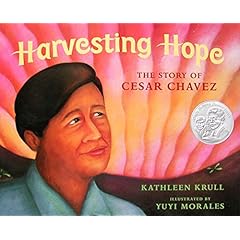
Harvesting Hope: The Story of Cesar Chavez

Harvesting Hope
The Story of Cesar Chavez

Author: Kathleen Krull, Illustrator: Yuyi Morales

Summary:

Harvesting Hope is a short biography of Cesar Chavez, a civil rights leader who founded the National Farm Workers Association. Before the creation of this organization, workers were not protected against harsh working conditions.
The book begins by describing Cesar’s childhood, which were filled with happy memories, until a drought in 1937 caused his family to lose their eighty acre ranch. This caused his family to become migrant workers, where they worked long hours in harsh conditions only to earn thirty cents a day (total of the whole family’s wages!). Cesar also went to an “English only” school, where he was ridiculed by his teacher for speaking Spanish. He dropped out after the eighth grade and continued to do farmwork. Later, he was inspired by outsiders to fight for change. He talked to various workers and persuaded them to join his fight. As word spread, more and more people joined in his protest through non-violent means. Eventually, the owners of the farms that many migrant workers worked on gave in and signed contracts with Chavez, which paved the way for fair treatment of all farmworkers.

Reflection:

I was first drawn to this book by its title: Harvesting Hope. The title fits with the story in the sense that Cesar was the one who began planting the seeds of change and through his efforts instilled/”harvested” hope in the farmworkers for better working conditions. Additionally, I have never really heard much about Cesar Chavez, and in the “author’s note” at the end of the book, there may be a clue as to why that is. According to the author, Chavez “was-and is-controvesial. Especially among those resistant to change, he had many enemies and received constant death threats. Even today, some argue about him and his goals, and others have forgotten him or have never heard of him.” Thus, through reading this book, I was able to find out more about him and it also made me wonder whether or not there were other important civil rights leaders whose names may have been ignored or forgotten over time.

Lesson Plan Ideas:
The following site is a teacher’s guide that contains several lesson plan ideas:
http://www.yuyimorales.com/guide.pdf

SJE Domains:
This book covers SJE domains #3 and #4. It explores issues of social justice in terms of workers’ rights and how Cesar Chavez struggled for social change through different forms of protest.

Curricular Units:
This book can be used in a civil rights movements unit study/curriculum or even to explore different forms of oppression in addition to the more well-known ones (i.e. racism, classism, etc.).

-amazon

-Illustrator's webguide to book

-Harvesting Hope Lesson Plan

The Three Questions


Title: “The Three Questions”,
Written and illustrated by Jon J Muth,,

Description:
“The Three Questions” is a book about a boy, Nikoli who has three questions and cannot rest until he finds their answers. His questions are: When is the best time to do things? Who is the most important one? What is the right thing to do? He asks his friends the dog, heron, and monkey who tell him different things, all of which are selfish answers. Still unsatisfied, Nikoli goes for a long walk and stumbles across his friend the old turtle digging his garden, so he began to help him. He asked the turtle the three questions and then a storm comes. Nikoli heard a cry for help and ran into the woods. There he finds a mother panda bear trapped under a tree. Nikoli rescues her and her baby. After the mother and baby bears are safe, Nikoli is still looking for answers. Finally, the turtle makes Nikoli realize that “there is only one important time, and that time is now. The most important one is always the one who you are with, and the most important thing to do is good for the one who is by your side.”

Reflection: The best part of this book is the illustrations, they are watercolor and enchanting. The storyline is meaningful and exciting for students to hear. Nikoli’s questions are questions that many people ask themselves at some point in their lives and to hear the answers that he finds is inspiring.

Lessons:
This book can facilitate discussions on how to be good citizens. It shows the importance of doing good for others.
Nikoli has many character traits that are evident in the story which makes this book wonderful for a characterization lesson. Students can not only list Nikoli’s character traits, but they can find evidence of it in the story.
It would be a good idea to have the students write a paragraph to ask their own three questions and try to answer them.
Questioning what’s going on in the world is one of the most important lessons we can learn, and this book can facilitate discussions about why its important to ask questions like Nikoli did.
This story is based on a story by Leo Tolstoy, so it would be a good idea to do a study of Leo Tolstoy with a group of fifth and sixth graders. Because Tolstoy wrote “The Three Tales” you could read it, and compare it to the “Three Questions” and then have the students write their own “Three Tales” story.
Heres a link about Leo Tolstoy: http://www.ltolstoy.com/etext/index.html

Levels of Social Justice:
This story addresses the fifth level of social justice education. Students are able to see Nikoli doing good for others, even though he didn’t know them. Through this book discussions can be raised about how to do good for the people in their town, school or anywhere. Nikoli sets an example of being a good citizen, which is one of the first steps to taking action for social change. After all, the last line of the story is “For these my dear boy, are the answers to what is most important in this world. This is why we are here.” This book is motivating and inspiring.

Alia's Mission: Saving the Books of Iraq


Alia’s Mission: Saving the Books of Iraq
By Mark Alan Stamaty
This book is based on a true story of Alia Muhammad Baker, the chief librarian of the Central Library. Alia loves her job and knows how important libraries are to society. Suddenly, war breaks out in Iraq. She begins to fear for the safety of the books when she sees that artillery has been placed on the roof of the library. At first she pleads with the government to help preserve the books but her requests are denied. So she starts to slowly remove the books from the library by hiding them in her purse and then stores them in her home. The war soon escalates and she decides to she needs others help her in the mission of saving the books and thus preserving the city’s great history and culture. Soon many people are inspired by her heroism and decide to aid her in the mission. Then one night the library is destroyed. Alia is incredibly distressed and faints. When she recovers she is delighted to know that she helped save over 30,000 books! She now is in charge of overseeing the plans of building a new and better library.
I was first drawn to this book because of the illustrations. The book is laid out like a comic book with different panels and speech bubbles. I also enjoyed the fact that the book focused on a female heroine who was Muslim, something that is rarely seen in books. I also enjoyed the way that the book showed Iraq as a modern country. Often people envision Iraq as a barren desert. This book however shows the city of Basra complete with stores, restaurants, cars, apartments, and libraries.
The book’s overarching theme that any person can be a hero is a great way to empower students. The book also offers some resources to contact if one wanted to get involved with helping preserve libraries around the world.
The book is also great for discussing the current war in Iraq. The website:
http://www.teachablemoment.org/elementary/iraqstudyguides.html
offers ways to use the book in order to illicit discussions of the war in an elementary classroom.
The book fits into several stages of social justice. It explores the issues of war and war’s effects.(stage 3) It can be used to empower students with the message that everyone can make a difference and that heroes can be ordinary people. (stage 4) The book also gives resources for ways students can get involved with helping to preserve libraries.(stage 5)

Thursday, January 25, 2007

Yertle the Turtle


Title: Yertle the Turtle
Author: Dr. Seuss

This Seuss story is about a turtle named Yertle that is the king of the pond and all that he can see. One day, he decided to have a few of the turtles in the pond climb on each others' backs so can can stand on the top of the pile and have a better view of much more land, therefore ruling over more territory. He gets greedier and greedier, forcing more and more turtles to stack up, despite the poor turtles' tired and aching backs. He seems unstoppable, until the small turtle on the bottom burps, causing all of the turtles to fall, and finally landing Yertle in the mud, powerless. This is when all of the turtles finally become equal and are no longer oppressed by the former king Yertle.

I was originally drawn to this book because I have always been a fan of Dr. Seuss. I enjoy his ability to capture the readers' interest with rhythmic word patterns, cartoon-esque illustrations, and amusing story plots. It was not until college however that I truly realized the depth of his books. Geisel (Dr. Seuss) includes valuable lessons and morals that relate to real-life, world events in many of his stories, such as Yertle the Turtle. This story in particular offers a critical look at dictatorship and the greed associated with the power struggle. The website http://www.cnn.com/books/news/9910/17/dr.seuss.war/index.html would be a valuable resource if a teacher decided to conduct an in-depth author study that not only included research on his past, but an analysis of his stories and underlying messages. This would be a useful skill in getting students to think about critically analyzing stories and books that they read to find the deeper meaning and a possibly hidden message that they are absorbing. includes information on Seuss's (Theodor Geisel's) history as a political cartoonist,and his intention with the book.

Another focus of the story could be a study of dictatorships of the past and present. One website,
http://school.discovery.com/lessonplans/programs/tlc-ancientrome/includes a lesson plan entitled "Dictator for a Day." It discusses the dictator of ancient Rome, Julius Caesar, and provides various discussion questions for the students to explore the concept of dictatorship. It also provides an activity in which a student would be appointed the classroom dictator, and would be allowed to make all of the rules and decisions for the class for the entire day. This could be done either before or after reading Yertle the Turtle allowing for personal reflection and connection to the themes within the story.

Another website I found that could be helpful for all various grade-levels was a website dedicated to exploring Dr. Seuss themes and activities.
http://www.vickiblackwell.com/seuss.html provides lesson plan ideas as well as printable versions of worksheets and activities for use in the classroom. It also provides many links to other Seuss and children's literature lesson plans and themes.

There are many different ways that this book can be used within a classroom. It could be used in any grade level from K-High school, depending on the depth of which the teacher decides to analyze the story. It can be used as a social studies/history focal point by covering government, dictatorships, civil rights, power struggles, oppression, perspective, etcetera. It can be used within the language arts spectrum as an author study, word study with the use of rhyming and the rhythm he chooses to write in. Mathematics can be included by looking at the number of turtles stacked in relation to how far Yertle could see into the distance, etcetera. It could also be used within a classroom in which bullying is an issue so that students can relate it to dictatorships and reflect on the problematic behavior.

This book clearly fits into two of the stages of social justice education, and could easily be used to enhance the fifth stage as well. It explores issues of social justice by exploring the oppressive consequences of power and dictators. It also relates to the fourth stage of social movement and change because the students saw that the one small turtle on the bottom of the stack was able to lead to the dictator being overthrown, allowing freedom for all. If the class discovers an issue of power abuse in their community, such as something they notice with a bully or other school issue, they could potentially write letters or discuss the behavior to make a difference in the classroom. This book has the potential to springboard many different meaningful, integrated themes and lessons within many different age groups in classrooms. I recommend it to any teacher, especially Dr. Seuss fans!


To buy the book: http://www.amazon.com/Yertle-Turtle-Other-Stories-Seuss/dp/0394800877


Smoky Night


Book: Smoky Night by Eve Bunting, illustrated by David Diaz

Summary:
A little boy watches the riots with his mother from their apartment. Later, their own building is on fire and as they are leaving, the boy realizes that his cat is not there. The neighbor Mrs. Kim, who is disliked by the community, is also missing her cat. The community gathers in a shelter to escape the fire and the riots on the streets. The story ends with the two cats being found together and teaching the humans a lesson about getting along.

Reflection:
The first thing that attracted me to this book was the illustrations. They were so real and reflected exactly what the author is writing about. Also, I thought it was really interesting that this book is about the L.A. riots, but no where in the book does it mention that. I This book can be helpful when teaching children about tolerance and racial conflicts overall. It also shows that during a time of need, race/ethnicity shouldn't matter because the only way to survive as a community is to work together.

Activities:
  • Students could do a writing activity where they talk about a time that they were scared and how they maybe tried to feel less scared.
  • Students could also do a writing activity where they talk about a time they felt courageous and did something they were proud of
  • Students could make an art collage in the style of the illustrator using daily objects

Curricular Units:

  • A unit on riots in the U.S. Explore the similarities and differences between these riots. The causes.
  • A unit on diversity overall

Social Justice Education:

Self-Love and Acceptance: Students learn about accepting themselves and recognizing they are different from other people.
Respect of Others: Students learn about accepting cultural differences and being tolerant
Exploring Issues of Social Justice: Students learn about racism
Social Movements and Social Change: The cats are used as a metaphor for social change and through that, the students learn about how in a troubled time, helping each other is the only solution.
Taking Social Action: Students explore how they can take action against racial prejudices and intolerant behavior.

Websites:

Where to buy the book: http://www.amazon.com/exec/obidos/ASIN/0152018840/timstore06-20

Candy Shop by Jan Wahl


Summary: Candy Shop is a children's book written by Jan Wahl and illustrated by Nicole Wong that addresses the isue of prejudice and racism in one's community. The book focuses on a young African American boy, Daniel, and his Aunt Thelma detailing a typical day spent together doing chores, getting haircuts, and ultimately rewarding themselves with a trip to the local candy store at the end of the day. The real content of the book only comes close to the end of the story when Daniel and his Aunt arrive at the candy shop. At first they notice a big crowd of people huddled around the store and the owner of the shop, Ms. Chu, is standing at the front crying. At first Daniel thinks people want the candy but quickly realizes that the people are gawking at a racial slur written on the sidewalk in front of Ms. Chu's shop. Daniel and Aunt Thelma enter the shop with Ms. Chu, who is apparently a friend of the two, and comfort her. Daniel tries to think of what a real cowboy would do in a situation like this one (throughout the story he hs been pretending to be a cowboy) and decides he should help clean the sidewalk clear of the hateful words. In the end Aunt Thelma invites Ms. Chu over for dinner and Ms. Chu gives Daniel some free candy for doing such a nice thing for her.

Feelings/Suggestions/Activities etc: I like this book for a variety fo reasons. One is because the main character is named Daniel, which i think is a great name, but also because it addresses heavy topics liek racism and prejudice in such a way that it is appropriate for younger children. Often i feel that adressing issues of social justice can seem difficult mainly because it is sometimes hard to find source material that is both age appropriate and legitamatly informative. This book is nice because it just grazes the issue calmly without introducing topics or concepts that would be difficult to explain. Perhaps the most tactful aspect of this book is that the racial slur that is written outside the shop is never specified or mentioned precisely. So, without introducing a hateful wod and then having to explain how one should never use that word the book addresses the topic broadly. One doesn't need to know slurs to understand their effects and this is one of the reasons why i think this book could work well to introduce the topics of racism and prejudice for students. I think that the best activity to do with students relating to Candy Shop would be to use it as a springboard to A: introduce the idea of racism in our communities and B: identify the damaging effects of prejudice, namecalling, etc. I would do a read aloud with my students using the book and then have a serious discussion with my students about what types of feelings the story brought up and how we can adress real life situations that are similar and may affect us.

SJE: This book addresses the topics of respect for others, exploring issues of social justice, and taking social action. I think the most important of these is the social action, since ultimately the young protagonist is the one who takes action and cleans up the sidewalk-which is both empowering to know that as a child you can make a difference.

In short: solid children's book with nice illustrations and the subtlty is not perhaps its strongest attribute.

Wednesday, January 24, 2007

Ish by Peter H Reynolds


Ish is about a boy named Ramon. Ramon loves to draw and it is what he does until his brother makes fun of one of his pictures. Drawing becomes such a struggle that Ramon gives it up. It is not until his sister reaffirms him that he is able to reconnect.
What I really liked about this book was the simplicity of the language and emotion. This enables children to connect and think on different levels. While the content is probably on level for a first or second grader I think this book could be used with any age. Last semester my CT used this book in our fifth grade class as part of community building/ conflict resolution. The structure of the book allowed the students to see how what we say can effect others. It also encourages ways to think positively.
Perspective is an issue that can easily be picked up from this book. Ramon's brother and sister both look at the same picture and see different things.
The most important thing I took from the book was encouragement to be creative. In addition, when you set your mind to something anything is possible; and perfection doesn't always matter. This ability to be creative and take risks in learning is integral to academic success.
Links:
This a clip of Reynolds talking about the work he does and his take on it.
This a site created by Reynolds with some resources for helping to encourage creativity in the classroom.

A Shelter in Our Car


A Shelter in Our Car
Story by Monica Gunning
Illustrations by Elaine Pedlar

A Shelter in Our Car is about a little girl, Zettie, and her mother's search for a better life in America. After her father died, Zettie and her mother left Jamaica to come to the United States. This book shows Zettie's mother struggle to find a job and obtain a better education in an American city. During her search, Zettie and her mother sleep in their car, search for food, wash up in public restrooms, and try to stay away from the police. Both characters show strength, love, courage, and determination despite the fact that they are without a home.

I was drawn to this book because of its colorful, unique illustrations. I also liked how the book showed the harsh realities of being homeless in America. Zettie and her mother are lovable characters that all readers can appreciate.

This book would be useful for all students to read and discuss in the classroom. In both my previous and current student teaching placements, students from NYC shelters have been a part of the class. I feel that this story would help these students understand that they are not alone in their struggle. The last page of the book tells its readers about homelessness in America and some reasons why people are homeless. This section of the book explains that all human beings have basic needs that need to be met and suggests ways individuals can help others meet their basic needs. The end of this book provides hope, information, and suggestions about how to be a part of the solution to homelessness.

A Shelter in Our Car addresses all five levels of social justice education. Self love and acceptance are shown by explaining both Jamaican and immigrant culture through the two main characters. Zettie and her mother show that they accept themselves and want to make the best possible lives for their family in America. The story demonstrates respect for others when the police officer helps Zettie. It also shows a time when respect for others was not present when Zettie's classmates make fun of her. Students could learn from the negative incidents that happen to Zettie when she is at school. Classism and homelessness are explored in A Shelter in Our Car, which addresses level three of social justice education. Zettie and her mother's story shows a struggle for social change. Both characters worked hard to overcome their hardships faced in America. Finally, the end of the story provides students/readers with information to learn about homelessness in America and ways to work for change. I think that students would learn a lot from this text and related discussions.

Children's Book Press provides an excellent teacher's guide containing detailed lesson plans, cross curricular activities, and additional resources.

Whoever You Are by Mem Fox


Title: Whoever You Are
Author: Mem Fox

Summary: This beautiful picture books talks about how children all over the world have differences (ie: color, race, education, homes, etc), but that every child shares a common ground. Every child loves, laughs, smiles, and cries.

Reflection: The reason why I really liked this book was because it was very simple yet, very meaningful. The author does explain that every child is different, but the author also mentions the similarities all children have. This would be a great story for the first day of school or even just for a read a loud. I would use this book to help create a comfortable, safe, learning environment that embraces all differences. The illustrations are absolutely beautiful and the book is very engaging.

Activities: I would read this book before the students make self-portraits. I would ask the students to list their unique traits and ask them to express those traits in their self-portraits. Then, I would make a Venn Diagram to show similarities and differences students have in the classroom. Students can even make a Venn Diagram with just a partner. One student can write their traits in one circle and the other student can write their traits in another circle. In the middle, they can write the similar traits that they share. This activity would help students to appreciate themselves and also learn about their peers. I would also have them do a writing assignment in relation to their self-portrait. The students would write and explain what they drew in their self-portraits. This would be a great way for students to take pride in their work and in themselves. I would also make copies of the picture on the cover of this book. I would ask the students to write what they think the picture means. Students would share some of their ideas and interpretations.

SJE: This book fits into the stages of social justice education. Through this book, children can learn about themselves, their culture, their personality, etc. They are also given the opportunity to learn about others and appreciate others. This book can lead to a discussion on social issues like racism and discrimination, which then brings the opportunity to talk about social movements and social action.

Freedom Summer By Deborah Wiles


Summary: This book tells the story of two best friends, a white boy Joe, and a black boy John Henry in the segregated south of 1964 America. The boys had many similar interests and hobbies, but were not allowed to publicly do many of those things, such as swimming in the neighborhood pool and buying freeze pops at the local store, because of segregation. The summer of 1964, also known as 'The Freedom Summer,' marked a pivotal change in history by passing laws that banned segregation. However, the boys soon find that laws passed and attitudes and actions still carried out do not always coincide.

My Opinion: This story is a great introduction for talking about segregation and civil rights. It explores the child-like innocence that exists while also exposing children to the unfair nature of a 'democratic' society. I think that it is well written and captures the youth experience. It makes you emphasize and want to change the unjust behavior. I also like the simple illustrations that depict hot summer days in the south.

Possible Topics: This book depicts the nature and emotions that exist with segregation. It also is a great way to introduce civil rights and laws passes in the 1960s. It also brings up the point of having laws passed did not mean that the way blacks were treated would change. It can also lead to discussions on what is fair and unfair and trying to see from the perspective of all races.

Literacy/ Social Studies Lessons:
  • Students could write journal entries from the perspective of either John Henry or Joe concentrating on having the students relate to the characters feelings.
  • The students could do character studies on either of the main characters and also compare and contrast the two boys using graphic organizers.
  • Students could write letters to local elected officials from the perspective of a community member of the Mississippi town telling the officials how the new laws are being treated and carried out.

Math/ Social Studies Lessons:

  • Students can calculate the wage differences between blacks and whites of various occupations in the1960s and compare the wage difference of whites and blacks today.
  • Students can research and find out the racial breakdown of the United States in 1964 and what the breakdown of elected officials in 1964 and compare. Analyzing the misrepresentation.

Social Studies Lessons:

  • Introduce and begin to analyze the Civil Rights Act. Do they agree with the laws? Do they think they were effective?
  • Consider and discuss the disparity of law and practice.
  • Discuss if they think that these unfair acts still occur today. Examples of unfair treatment and segregation that the children think of can lead to them writing proactive letters to the organizations or those in charge of the unfair acts.

Because of Winn-Dixie


The book I chose was Because of Winn- Dixie By Kate DiCamillo. Because of Winn- Dixie is a book about a girl named Opal who lives with her father, a preacher. She has recently moved to a new town and has no friends. Opal finds a dog, Winn Dixie, who , with a smile always on his face seems to attract people which helps Opal make friends. Opal 's friends are a very eclectic group ranging from the "witch" to a musically gifted mentally disabled man who spent time in jail. Opal learns what is really important in life and how important it is not to make judgments about people without getting to know them.
Because of Winn-Dixie
not only tells a delightful story, but also it addresses several socially sensitive and pertinent issues that many young people encounter today. The story includes references to alcoholism, prejudice, the elderly, death, single-parent families, and the importance of community.
This book is a great book to use to teach children about social issues as well as literacy Kate DiCamillo uses the main character's inner voice, a strategy that students are introduced to during writing. This book is a heart wrenching book. It can be easily used by teachers for not only literacy, but also to help the students reflect about their own life as well as the lives of others and see how they intermingle. The students are encouraged to question the reasoning behind many of the authors seemingly simple characters and events for they often can be understood at a much deeper level.
This book fits almost all levels of social justice because it discusses people's differences, prejudices, and ends with Opal taking social action. She plans a party for all her new friends to attend and thus brings all the townspeople together allowing them to see for themselves the dangers of judging others too quickly.
Examples of curricular units could be writing realistic fiction, symbolism, social interaction/peer relationships.
http://www.enotes.com/because-winn-dixie-qn/, http://www.webenglishteacher.com/dicamillo.html,http://www.rif.org/educators/lessonplans/winn-dixie.mspx,

Martin's Big Words - Doreen Rappaport


*I hope that worked!! If not, the link to that amazong page is,
http://www.amazon.com/gp/reader/0786807148/ref=sib_dp_pt/104-3692424-5398365#reader-link

Book
Martin's Big Words, by Doreen Rappaport

Summary: This is the story of Martin Luther King, Jr. growing up in the South, seeing things he did not like (for instance, a 'Whites Only' sign), and deciding to change it. Very biographical, and shows students what a difference one person can make. Except for the ending, I think this is a great book to have in your classroom.


Social Justice Education
Touched upon many of the levels of Social Justice Education we have been speaking about. I would venture to say it hits all 5: Martin's mother telling him he was just as good as anyone else, Martin telling people to use their voices and not their fists is respectful of others, and the entire Civil Rights movement explores social justice and change. Clearly, through things like the Montgomerey Bus Boycott, and the ending of Segregation in 1964 at his hands, students can see how one person can make a difference.

Curriculum/Units the book touches on
The ideas of Slavery, Segregation, Integration, Civil Rights, Social Action, Social Justice, Inequality, Racism, Racial Relations, the Power of the Individual, Violence, Non-violent Protest, and the Power of Words come to mind instantly. Showing students how much they can accomplish with a dream and hard work - that it ISN'T up to someone else. They could be that someone who makes a great change in our world that is in such desperate need of change, which would be great for self-esteem and empowerment. It is also important for them to reflect on the fact that he, like Ghandi, refused to give in to the temptations of violence, finding other creative ways to solve the problems he saw around him. His story shows the power of believing in yourself, and being a good leader. It will also inspire students to think of things in their communities that they don't like and want to see change; and then can try to think of how they can help start that change today.

Other Notes on the Book

Personally, I think the pictures are gorgeous, and I like the illustrator (Bryan Collier)'s use of fabric-looking pieces to make up backgrounds and articles of clothing They are detailed and gorgeous to look at. It's not typical illustrations, and I think students will appreciate how interesting the pictures look, and may want to learn how they can emulate this in their own publishings (of course, it's no photocopies-and-cray-paz work, but it will do).

As I mentioned earlier, my biggest complaint is the abrupt, somber ending. It is the truth, that he was shot and that he later died from it, but the rest of the book was worded so beautifully, I felt a little more tact could have gone into the last thing the students will remember of the book. I guess that could have been the author's intent, a shock-value, but if I was reading this to a younger class, I would think of my own way to say it.

Jumping back to the positives, the book is entitled "Martin's Big Words", and on each page, we get a small snippet from all of Doctor King's famous speeches, which really shows the power of his words, and give a glimpse to how wonderful this man and his ideas really were.

Also, at the back of the book, it gives a substantial listing of other books and websites that can be visited to learn more about the life of Doctor King. Here are some of them (sorry, I don't know how to do this link thing yet!)

A Picture Book of Martin Luther King Jr. - David A. Adler
If You Lived in the Time of Martin Luther King - Ellen Levine
My Dream of Martin Luther King - Faith Ringgold
My Story - Rosa Parks and Jim Haskins
He Had a Dream: Martin Luther King, Jr. and the Civil Rights Movement - Flip Schulke

http://www.kidsdomain.com/holiday/mlk/index.html
http://www.surfnetkids.com/king.htm
http://www.kiddyhouse.com/Holidays/MLK/MLK.html *this one says it has thematic lessons on it*
http://fun.familyeducation.com/martin-luther-king-jr/activities/32832.html

Monday, January 22, 2007

BOOK CLUB


Book: a sweet smell of roses by angela johnson (lower case on the book cover too, which I found rather odd).

Summary: Two young girls sneak out of their house, down the street and across the town to where men and women are gathered, ready to march for freedom and justice.

Reflection: I enjoyed reading this book. I chose this book because the cover of the book made me interested in knowing more about it. It is an easy read and I think it would be best for older grades so you can have more of an in depth discussion of what is going on, but it could be used for all grades as well. The pictures are black and white, but they are wonderful. I had an idea of what was going on by looking at the pictures alone. The pictures showed unity, oppression, different emotions and movements. The color red is used for the flag, the bear's ribbon and the red roses.

Activities: I would use this book to talk about how people sacrificed for freedom in the past and connect it to how people are sacrificing for freedom today. I would also use this book to study justice, injustice, oppression, tributes, how people create change, power and bravery, marches/pickets, leaders/followers, the civil rights movement, community and staying together, fighting for what is important, having the kids pretend they are MLK and writing what they would want to change and why-then make a class book about social change.

Curricular Units: Social Studies: Civil Rights Movement 1950's - 1960's, Study People: Rosa Parks, MLK, Malcolm X, Robert Kennedy. Literacy: speeches

SJE: This book addresses EVERY stage.
1) Children are learning about their own culture, what is going on around them, they are accepting it, loving themselves, family and community while being a part of change.
2) There was opposition, but they continued to mind their business and march without fighting. They built community by respecting one another.
3) Oppression, marches, standing against the forces of injustice.
4) Being a part of a social movement, being a part of the struggle.
5) The two girls were part of the marches and played a role in social action/change.