Saturday, March 17, 2007
Chi- Hoon

Josephine's 'magination by Arnold Dobrin
The multi-cultural content comes from the book taking place in a poor neighborhood on Haiti, a country i assume most young urban students are not familiar with. Students learn about different cultures and people and there is also a bit of self love and acceptance in regards to the character of Josephine. (she learns she can have fun and make toys even though she has no money to buy anything, accepting her situation and making the best of it) I would use this book as an opportunity to introduce Haiti and Haitians to students. Where is Haiti? What continent is it located on? What is the weather like there? Can we determine any of this from the illustrations or how the people dress? What language do they speak in Haiti? (French) Why do they speak French? (Haiti was a French colony as well as many other North African states)What's a colony? etc. you get the idea. Any number of engaging and enlightening questions could be asked. For more advanced or older students you could have them do their own research and investigations into the Haitian people, culture, and history. One must keep in mind however to prepare students with adequate research skills and strategies before assigning such an activity.
Friday, March 16, 2007
Somewhere Today... A Book of Peace

Somewhere Today..A Book of Peace by Shelley Moore Thomas
At first I felt as though this book did not really have much to do with peace at all because it only presented alot of positve scenarios, but after observing the literary specialist in my school do a read aloud with this book I realized that there is alot of potential to discuss what peace is and contrast the postive imags with other negative aspects as well. This book goes through different activities that children are doing throughout the world that help make the world a better place. I love that the book has actual photographs rather than illustrations as well. More than that this book presents taking social action in a way that children can relate to and dispels the idea that social action has to be some grandiose display, that way children can see it is possible to be a social activists no matter how old and how little a taks may seem.
Social Justice
4.Social Movements and Social Change
5. Taking Social Action
Lesson Plan Ideas.
I think this book would be a great book for a writing unit where children are making their own books, as well as a poetry unit.
Wednesday, March 14, 2007
"I Love My Hair" by Natasha Anastasia Tarpley

Title: "I Love My Hair"
Author: Natasha Anastasia Tarpley
Reflections: I strongly recommend this book for any grade level. Its illustrations and colors make images vivid and immerses readers into a realistic flight of heritage celebration. Overall, it is a beautiful story about self-love and acceptance.
Social Justice Education: This book could be used in lessons that deal with self-love and acceptance, respect and tolerance for oneself and others, and exploring issues of social justice in the classroom. Also, it is great to read to students when introducing appreciation of diversity in the classroom.
Lessons and activities: This book is an excellent resource to use when teaching a lesson on the Appreciation of Diversity. First, I would read this book to my students and after ask them to draw self-portraits. When finished, I would allow students to comment about their differences in a positive way while they travel around the room viewing their drawings.
You may also want to visit this interesting link: A unit on "Celebrate your Heritage"
http://content.scholastic.com/browse/unitplan.jsp?id=50
Stand Tall, Molly Lou Melon
 This book is a "heart-warmer" about a little girl named Molly Lou who is smaller than all the other children her age. Her character is developed after she moves to a different town. She always remembers what her grandmother told her and is able to battle the bullies.
Stand Tall, Molly Lou Melon would be useful in the younger grades as it has very simple language and bold pictures. This would be good for character development lessons and the theme of being proud of who you are. It also is a good example of how we need to to accept people who are different than us. Some possible lesson ideas would be to have children compare the situations from the book to things that have happened to them. Another idea would be to use this as one book in a character study unit. Students could record aspects of Molly Lou and what makes her who she is.
This book does not reach all of the levels of social justice education. It clearly touches on self-love and acceptance as she is constantly reminded that she can do what everyone else can do. It is also able to be incorporated into the "respect for others" category because the bully Ronald learns to accept Molly Lou for who she is.
Some useful links:
http://www.uen.org/Lessonplan/preview.cgi?LPid=10582
http://www.meac.org/Resources/LessonPlans/pdf/Primary_stand.pdf
http://teacher.scholastic.com/lessonplans/bookfairs/currconnection/like_myself.htm
People

Written and Illustrated by Peter Spier
People is an excellent book to use in the classroom to expose students to the differences in people from around the world. Spier's book sends the message that everyone has the right to be different and that people should be proud of their differences. Spier examines an array of characteristics that make human beings unique. His words and illustrations show the differences in physical traits (body size, skin color, eye color, hair style), clothing styles, interests, dwellings, holidays, foods, religions, and languages of individuals from many cultures. At the end of the book, Spier asks the reader to imagine how dull the world would be if everybody looked, thought, ate, dressed, and acted the same. This book makes you think about how wonderful it is that each one of us is unlike any other.
Anne Marie and Bree pointed out one area to watch out for: towards the end of the book, Spier writes about the different kinds of leaders. We noticed that the illustrations for this page are all of white males. When using this book in the classroom, it might be beneficial to discuss this or to skip the page entirely.
I think this book touches on the first three levels of social justice. When reading this book, children and adults consider their own cultures. They also learn about cultures that are different than their own. Spier helps his readers realize the importance of differences in the world.
Tuesday, March 13, 2007
Fire at the Triangle Factory by Holly Littlefield
Available for Purchase at: Amazon
Summary: This book is about two 14-year-old girls, Minnie a Jewish girl and Tessa an Italian Catholic girl, seamstress coworkers in a crowded work factory on the upper floors of a building in Greenwich Village (Now the Silver building on NYU’s campus) in 1911. One day a fire breaks out in the factory, resulting in the deaths of 146 workers. The book tells the story of the two girls struggle for survival. This historic event in history changed the labor laws and safety codes for the future generations.
My Opinion: I love this story because it tells a story of child labor, religious differences, and overlooked labor laws. It is a story of tragedy that results in social change. It also is very relevant for children in New York City because it tells of specific landmarks and communities that the children live in today.
Possible Topics: You could use this book for numerous lessons and unit studies! It covers topics of labor laws and how they were neglected and obscure before the fires. It covers child labor. It discusses the importance of safety and evacuation plans. It discusses the life of immigration work and New York City. It also talks about the religious differences and family opposition among the Catholics and Jewish communities of the early 20th century.
Lessons in literacy/ social studies:
· The students can role-play and write a letter from one of the girls’ perspective to the other girls’ perspective telling about why they think their parents dislike each other.
· Write diary entries from the girls’ perspective about the daily life in the factory or the day of the fire
· Write letters to the government officials to make labor laws stricter and enforced
Lessons in math/social studies:
· The students can research and calculate how much money the workers made at the Triangle Shirtwaist Factory
· The students can calculate the ratio of how many people died in the fire and how many people were working there.
Lessons in Science/social studies:
· The students can research how the fire began and what caused the fire.
· What made the fire spread so rapidly?
· Brainstorm solutions and preventions that could have been enforced to prevent the fire.
Monday, March 12, 2007
Angel Child, Dragon Child
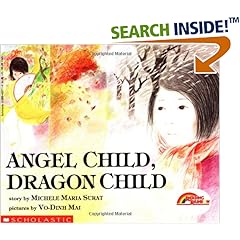 Angel Child, Dragon Child
By Michele Maria Surat
Summary: Ut is a new girl that has just come from Vietnam. The students in her class make fun of her because of her language and identity. She struggles attending school in the United States. Her mother is left behind Vietnam, but her once enemy, but now friend at school, gives her a big, great surprise at the end of the story that she will never forget.
Activities:
1) This book would be great to read on the first day of school. It will allow students to understand how other students might feel on the first day. Students can also learn that English is not the first language for all students. The teacher can maybe speak in another language and ask the students how they felt when they heard the language. This will allow the students to think about how others would feel.
2) I also think this would be a great book to introduce the Asian culture. Since many students might assume that all Asians are Chinese, this book can lead to an Asian culture study. Students can learn that Asians are Chinese, Korean, Japanese, Taiwanese, Indonesian, Vietnamese, etc. I find that it is important to understand that concept.
3) This would also be a great book for students to understand what it means to help others. One of the characters in the book help Ut, the Vietnamese student, bring her mom to the States. This can help create a positive learning environment.
Social Justice Education:
I think this book mentions self-love and acceptance, respect for others, and taking social action. Students learn to love themselves and their culture, have respect for the cultures of others, and also learn the importance of helping others out.
Sunday, March 11, 2007
The Keeping Quilt

A little girl, Anna comes to America from Russia with her family. When her and her family's clothes don't fit anymore, they use scraps of it to make a beautiful quilt to remind them of backhome. The quilt served many purposes throughout the years, as a wedding huppa and wrapping the newborns of each generation. The quilt is passed on to each daughter.
This book is a great memoir piece that uses an item, the quilt as a unifier. It is also great for studying cultures, traditions, immigration and families. It explores the changes that most families go through after they immigrate to America.
SJE:
1. Self Love and acceptance: the family is Jewish and passes on the traditions and cultures to each generation.
2. Respect for others: exploration of Jewish culture; throughout the generations, more people of other cultures are invited to the Jewish weddings.
3. Exploring issues of social justice: the symbolism of the quilt- all the things the family left behind to come to America and what identifies them.
Don't Laugh at Me!

This book, "Don't Laugh at Me", by Steve Seskin and Allen Shamblin, with illustrations by Glin Dibley, is really a book form of the song "Don't Laugh at Me!" by Peter Yarrow (of Peter, Paul, and Mary fame). It is an excellent resource for teaching an anti-bullying curriculum, as well as for the opposite of bullying, community building. It's hard to find in print (none of the book stores down here had it, but there was talk of the Barnes and Noble on 82nd...right...), but it IS still in print, and apparently comes with a recorded version of the song, which I think is really helpful for students who maybe can't read the words on their own.
My main concern with this book, however, is the fact that 'the chorus' says, "In G-d's eyes we're all the same", which is a really nice sentiment, but isn't great for community building if some students in your class don't believe in G-d or might get upset because they believe in another G-d or a different version OF G-d. I would try to find a more neutral way of expressing it - I was playing around with "in real life, we're all the same".
I believe this book hits the following levels of Social Justice Education:
1) Self-Love & Acceptance: it's okay to be different
2) Respect for Others: The basis of not bullying
3) Exploring issues of Social Justice: Why people get bullied, even though it's not okay OR their fault
4 & 5) dependin on how you use it: if you use it to discuss how a person's skin color has been a source of discrimination for hundreds of years, you could work this book in. If your students want to create a school-wide anti-bullying campaign, this would help.
Links:
http://www.operationrespectct.org/
http://www.operationrespectct.org/song.htm (a page with the actual song playing behind it!)
http://www.antibullying.net/
www.mikebogdanski.com/
http://www.theantibully.com/
links reviewing the book:
http://www.bookloons.com/cgi-bin/Review.ASP?bookid=3134
http://www.curledupkids.com/dontlaff.htm
http://www.amazon.com/Dont-Laugh-Reading-Rainbow-Book/dp/1582460582
Saturday, March 10, 2007
We Dream of a World

Title: We Dream of a World...
Authors: Scholastic; Classroom of students from University City, Missouri
This book is made by a classroom of students and dedicates a page to each social justice issue they wanted to focus on. Each page/topic includes facts and a few ideas of what we can do to help this issue. Some of the issues include hunger, homelessness, education, pollution and peace. This is a great way to not only introduce many topics of social justice to your class, but also to show them that kids can make a difference.
I would use this book to introduce and incorporate social justice themes into my classroom by reading a page/issue biweekly. This would give them a chance to brainstorm ideas of how they could help. They would then be encouraged to write letters, educate their peers, or incorporate other ideas and activities to take social action. This book could be incorporated into thematic units, or integrated into multiple areas such as literacy, math, or science and health. An example would be to look into a nutrition unit and encourage the school to sell healthier snacks in the lunchroom by writing letters to the school board.
This book covers three levels of social justice education. 3 because it shows issues of social injustice; 4 because it suggests ways for social change; and 5 because it encourages the opportunity to make a difference.
Friday, March 9, 2007

Dinner at Aunt Connie's House BY Faith Ringgold
This is a story about a young girl named Melody who goes to her aunt Connie’s house every summer for dinner and a special showing of her aunt’s artwork. Melody meets Aunt Connie’s adopted son Lonnie and they play hide and seek, in the house, before dinner. While playing hide and seek, they find Aunt Connie’s portraits of African American Women who have made great contributions to American History. The portraits talk to Melody and Lonnie; they tell both of them about their lives and how they contributed to American History. This book is great because it gives a brief description of these women and you can see how they look. This good contains a lot of valuable information that used in many different ways in the classroom.
This book can be utilized in the classroom by having students draw their own self portraits and write their own description of themselves. They can write about what contributions they made. This book could also be used as a starting point for research papers. Students could pick one woman they want to learn more about and they can research and make a presentation to the class. The students could even do a skit and act like the women they are researching. They could even act a dinner scene in which they students are portraying the women in this book. The students could also write something that they would want their portrait to say 50 years from now. How do they want to change the world? What do they want to be known for? The first woman to do… The first man to do… Being that the book was inspired by a quilt; the class can make a quilt out of their own portraits.
This book addresses all the stages of Social Justice Education.
A Friend Like Ed by Karen Wagner

Thursday, March 8, 2007
The Hundred Dresses by Eleanor Estes

This book tells the story of a little girl named Wanda Petronski. She’s not like her classmates, she has a funny name and wears the same faded-blue dress to school every day. Though she wears the same dress everyday Wanda claims to have one hundred dresses lined up in her closet at home. Her claim among other things makes her a target for the bullying by several other girls in her class Eventually, the bullies come to find out that Wanda did have one hundred dresses and also find out how their teasing game effected Wanda.
I think this book addresses many issues related to social justice such as immigration, poverty, and bullying. I think it does a good job of showing how bullying does not always have to be a physical assault and that words can really hurt. I also like how these issues of social justice are intertwined and that the book addresses the effects these issues have on children.
This website offers some lessons on how to use the book to engage students in a discussion about having courage and standing up for things they know are wrong http://www.bu.edu/sed/caec/files/elemlesson2.htm
I think this book addresses these levels of social justice: Stage 2 because it teaches students that people that are different from them have talents and qualities that they can appreciate. Stage 3 because it explores the issues of poverty, immigration/racism, and bullying. I think that this book could definitely be used to motivate students to work for change especially through such lessons that put them in a characters role and challenge the students to act in a way that may be different from their normal manner.
Wednesday, March 7, 2007
My Painted House My Friendly Chicken and Me

MY PAINTED HOUSE MY FRIENDLY CHICKEN AND ME
by MAYA ANGELOU
Summary: The book is from the point of view of a 8 year old Ndebele girl from South Africa named Thandi, meaning hope. She describes her life in the village: her best friend who is a chicken, the houses that they paint in the village, and also the beads that her mother wears. She is asking the reader to embrace her life and become her friend. The photographs in the book are real photographs, making the reader feel so close to the village. The books is also interestingly designed because the layout of each page is very different. Not only do the layout of the pictures change but the fonts size and style also changes.
Activities: 1)Students can make a book about their culture and customs in the same form as this book. They can write it as if they were talking to Thandi or someone who has never experienced their lifestyle
2)Students can find similarities between their life and Thandi's life
3) Students can describe their best friends and what characteristics make a good friend
Social Justice Education: This book addresses Respect for Others because it exposes kids to another culture and different It also addresses Self-Love and Acceptance because it teaches kids that being different is okay and one should be proud of it.
Friday, February 16, 2007
Fireboat: The Adventures of the John J. Harvey by Maria Kalman

Activities:
1)Students write a poem describing the characteristics of a hero
2)Students make appreciation cards for people who have jobs that impact the students' lives
3)Characteristics of Heroes: Write a list of character traits on the board (like bravery, intelligence, etc). Go through the character traits one at a time and discuss whether each particular trait would make a person a hero. Then have the group write down which of those traits they see in their friends and in themselves.
4) Empathy and Peace Building Activities
5) "If I Were a Hero, I Would…" Will they care about their friends, help their parents, be kind to people, say hello to neighbors? This exercise encourages students to think of themselves as heroes and feel good about it.
Social Justice Education: Covers all areas
Through the activities listed above, students will learn about self-love and acceptance, in addition to respecting and loving other people.
This book can also be used to discuss what happened on September 11th, andthe children can generate ideas on how the protect their country. What would they do if they were the President?
Sunday, February 11, 2007
I SEE THE RHYTHM BY TOYOMI IGUS

Summary:
"I See The Rhythm" is a very rich book with beautiful illustrations on the history of African American music. It goes into great detail how music has evolved over the past 500 years; from early 1500's to present day. Additionally, NYC's legendary Savoy Ballroom, the Apollo Theater, and the Cotton Club are given special focus.
Reflection:
This is a Wonderful book that provides the history of African American music alongside with information and dates of what has transpired historically. Igus makes it easy to connect history to each musical era.
Activity in Social Studies:
Students can work with maps of Africa and the U.S. and show how blacks originated in Africa and migrated to the U.S. They can then begin to connect the different musical eras that have evolved:
Slave Songs, Blues, Ragtime, Jazz, Swing, BeBop, Gospel, R&B, Rock-n-Roll, Funk, and Rap/Hip Hop.
Social Justice Education:
Students will learn self-love and acceptance as they learn about their own culture; respect for others as they learn about other cultures; exploring issues of social justice as racism, sexism, and classism are confronted; social movements and social change show how people have struggled for social change; and taking social action- students will understand how music has worked towards a non-violent social change.
Wednesday, February 7, 2007
Let's Talk About Race by Julius Lester
 Summary: This book explores the issue of race and racism. What would happen if there was no race? Aren't we all the same? Each individual has their own story, and their race is just one part of their whole person. Filled with beautiful illustrations and uses more developed concepts of race.
Reflection: The book presents several stories of different people, and demonstrates how not everyone is the same, however, we all are still human, and therefore, we are all equal. This book gets across this idea strongly, and is a great source for discussion about race and concepts revolving around human equality. I would gear this book to children 2nd grade and above, for maximum advantage.
Activities:
- Each student creates a portrait of themselves, and explains their story.
- Useful for debates about race and its existence in our society
- Exercise in multiple perspectives and stories of individuals
- Students create a play in which each child gives a monologue of their own story
- Make a mural of all students, one with their skin color, and one without, showing that no matter what skin color an individual is, they have the same interests, etc.
Tuesday, February 6, 2007

Harlem Stomp: A Cultural History of the Harlem Renaissance
By: Laban Carrick Hill
Summary:
This is a non-fiction resource book. It is a compilation of texts on the Harlem Renaissance. It does not have to be read cover to cover, but can also be enjoyed in segments. It calls readers to think about this time period in American, and NYC history.
How I would use this:
This sheds light upon a very important question. This book asks, why it was necessary for there to be a Harlem Renaissance. Why was it a big deal that people from Harlem were creating wonderful things? This shouldn’t have been surprising, it should have been assumed that people from Harlem, just like all other people, would be creating stunning work. Through these questions a teacher can include this work in a studies ranging from slavery to contemporary race relations in the US. This book can be used for older grades, but can also be adapted and segmented to fit the needs of younger children. Teachers should use caution when utilizing this work, due to the fact that much of the material inside is sensitive and often not censored.
Websites:
http://mercury.educ.kent.edu/database/eureka/detail_book.cfm?BooksID=1414
http://www.twbookmark.com/children/educator_resources.html
Social Justice Education:
I feel as if this book is an example of level four, Social Movements and Social Change. It discusses the Harlem Renaissance and provides students with the ability to access this time period.
*Posted for: Valerie Bracco*
The Village Basket Weaver

Summary:
The Village Basket Weaver by Jonathan London takes place in a quaint Carib village in Belize. This is a touching story about young boy, Tavio, and his aging abuelo (grandfather), Carpio. Tavio spends time watching his grandfather work on weaving a basket used for preparing cassava bread (a bread native to Belize) and starts to realize that his grandfather is not as strong as he once was. At the same time abuelo wonders who will carry on this important Garifuna cultural tradition of basket weaving, since all the young boys in the town are leaving to find jobs in the city. The interesting characters in this story (of African and Carib Indian decent) have done a good job of preserving their cultural but they face increasing pressure from the industrial world to become more modernized.
How I would use this book:
∙ Unit on the importance of preserving culture/ embracing where we come from and who we are.
∙ Unit about breads from different countries
∙ A unit about the Caribbean and/or people from South America
Helpful Links:
http://www.lessonplanspage.com/SSLAOFamilyTraditionsCulture12.htm
http://www.amazon.com/Village-Basket-Weaver-Jonathan-London/dp/0525453148
Domains of Social Justice: 1) Self love and acceptance: Children learn to appreciate their own culture and the importance of preserving it. 2) Respect for Others: Children can learn about a culture that is very different from their own. 4) Social Movements and Social Change: Children see how cultures are being pressured to change due to globalization.